Showing posts with label Regulatory Compliance. Show all posts

Monday, April 23, 2018

REACH, ROHS, Prop 65 and Other Chemical Compliance Certifications

Caltha LLP Project Summary

Project: Certification of REACH, ROHS, Prop 65, Conflict Minerals, Biocidal Products Compliance
Client:
 Component Manufacturer 
Location(s):
 Minnesota

Key Elements: EU Chemical Regulations, California Proposition 65 Labeling, Conflict Minerals Compliance Certifiaction

Overview: Caltha LLP was retained by this component manufacturer to compile compliance documentation and to prepare Certification of Compliance. Certification of compliance was required by customers who purchased manufactured components and incorporated them into their final products which were exported to the European Union and other areas.


Caltha prepared a certification form and background information to be completed by raw material suppliers that allowed each supplier to provide an informed certification statement regarding presence/absence of regulated chemical substances, and if present, documentation that concentrations are below regulatory thresholds.


Thursday, March 1, 2018

Maintenance of Legal And Other Requirements List For Pennsylvania Facility

Caltha LLP Project Summary

Project: Update and Maintenance of Legal and Other Requirements Listing
Client: International Steel Manufacturer
Location(s): Pennsylvania

Key Elements: Review of regulatory requirements, preparation of ISO 14001 documentation of legal and other requirements

Overview:  Caltha was contracted by the client to provide technical support to maintain their listing of "Legal and Other Requirements" which was prepared to conform to ISO 14001 Clause 4.3.2. An environmental management system that conforms to ISO 14001 must include a procedure to identify legal and other requirements that the organization believes are applicable to its operations. The organization also needs to have a system to be able to access the current version of these requirements.

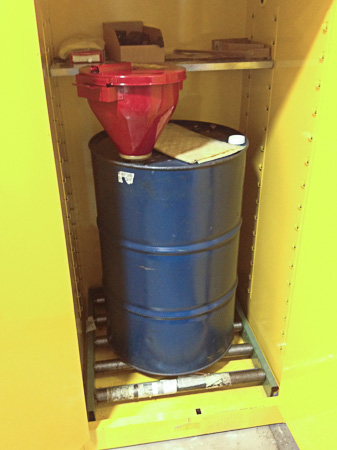
]Hazardous Waste Storage Drum In hazardous waste storage Cabinet
Hazardous Waste Storage Drum In
Flammable Cabinet


The list of requirements is also essential for complying with other Clauses of the standard. This list becomes the scope of scheduled compliance audits the organization must perform. Caltha provided a technical update to the organization's existing listing of requirements, which included several new regulations that had been recently promulgated on both the Federal and State level.

The most recent update included important changes to the hazardous waste management requirements and Pennsylvania stormwater permit requirements, included in:


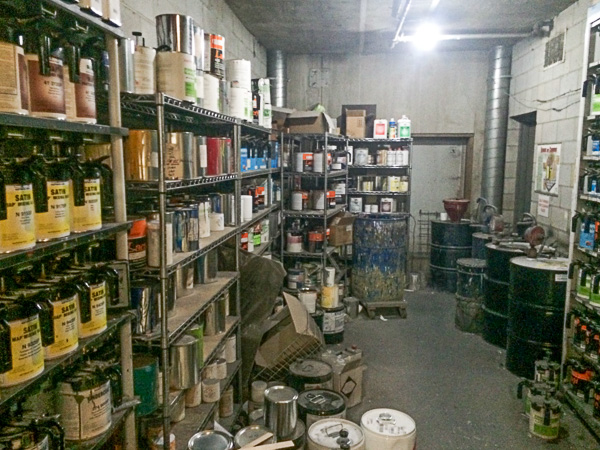
Designated storage area for Flammable Liquids and Ignitable Hazardous Waste
Flammable Liquid and Ignitable Hazardous Waste
Storage Room


For more information on Caltha LLP services, go to the Caltha Contact Page


expert consulting support of EH&S program development, compliance management, auditing, environmental management system, and safety management system. 
Caltha LLP | Your EH&S Compliance, 
Auditing and EMS/SMS Partner

Sunday, December 10, 2017

EHS Auditors To Supplement Audit Teams Or Fill Subject Matter Expert Roles

Caltha LLP has environmental and safety compliance and management system auditors available for short-term assignments to supplement audit teams or to provide Subject Matter Experts for auditing projects. Click here to review recent audit project examples.

Caltha staff have experience conducting EH&S audits in most US States and Canada. Caltha also has performed media or regulatory specific audits, including:
  • Product stewardship audits
  • Product responsibility audits
  • Waste - hazardous waste audits
  • TSCA audits
  • Air permit compliance audits
  • Wastewater compliance audits
  • Tank compliance audits
  • Risk Management Plan audits
For more information on the availability of short-term auditors to supplement audit teams or to full specific SME roles, contact Caltha at info@calthacompany.com

Wednesday, October 11, 2017

Beryllium Worker Exposure Rule Deadlines

OSHA has issued a final rule limiting worker exposure to beryllium and beryllium compounds. The rule contains standards for general industry, construction, and shipyards which take effect on May 20, 2017. Employers must comply with most elements of the rule starting March 12, 2018.


The key provisions of the rule are:
  • Reduces the permissible exposure limit (PEL) for beryllium to 0.2 micrograms per cubic meter of air, averaged over 8-hours.
  • Establishes a new short term exposure limit for beryllium of 2.0 micrograms per cubic meter of air, over a 15-minute sampling period.
  • Requires employers to: use engineering and work practice controls (such as ventilation or enclosure) to limit worker exposure to beryllium; provide respirators when controls cannot adequately limit exposure; limit worker access to high-exposure areas; develop a written exposure control plan; and train workers on beryllium hazards.
  • Requires employers to make available medical exams to monitor exposed workers and provides medical removal protection benefits to workers identified with a beryllium-related disease.

Click here for more details on the safety, health and emergency preparedness services Caltha provides.


Click here to review a sampling of our past safety related projects.

Thursday, October 5, 2017

Silica Rule Is Enforced Starting September 2017; General Industry Rule in 2018

US OSHA began enforcing the respirable crystalline silica rule for the construction industry on September 23, 2017. The rule had been set to go into effect in June; however, the Department of Labor and OSHA delayed enforcement of the rule by 90 days. The delay was intended to provide DOL and OSHA additional time to issue guidance to industry regarding compliance. The construction silica rule is a companion to OSHA’s general industry silica rule that is scheduled to be enforceable beginning June 23, 2018.

The rule lowers the permissible exposure limit (PEL) for respirable silica dust in the construction industry, to 50 microgram per cubic meter exposure limit, calculated as an eight-hour time-weighted average (TWA). Employers subject to the construction rule may comply by implementing required engineering and work practice controls and respiratory protection , or by completing exposure assessments  of employees above the action level of 25 micrograms per cubic meter.

Under the rule, employers must:
  • Make medical screening available to employees who are required to use a respirator more than 30 or more days per year;
  • Develop a written exposure control plan;
  • Maintain certain records; and
  • Comply with certain limitations on housekeeping practices, such as using wet sweeping, HEPA-filtered vacuuming, or other methods designed to reduce employee exposure when feasible.


Caltha LLP provides specialized expertise to clients nationwide in the evaluation environmental rules, developing EHS compliance procedures, and preparing cost-effective EHS management programs. For further information contact Caltha LLP at info@calthacompany.com or Caltha LLP Website

Friday, July 21, 2017

Chicago Multimedia Compliance Audit For Manufacturing Plant

Caltha LLP Project Summary


Project: HSE Compliance Audit
Client:
High Tech Manufacturer
Location(s):
Chicago, Illinois


Key Elements: EH&S audit, hazardous waste, air permit, hazardous material storage, wastewater permit, PPE assessment, hazard communication


Overview: Caltha LLP conducted a multimedia environmental, health and safety audit of this manufacturing facility located in Cook County. The scope of the audit included:

  • EPCRA
  • Hazardous and Solid Waste Management
  • Current IEPA Air Permit
  • Cook County Air Emission Ordinance
  • Current wastewater discharge permit
  • TSCA
  • Tanks
  • Hazard communication
  • DOT Hazardous material transportation

The audit was led by a IIA-certified professional auditor.


For more information on Caltha LLP services, go to the Caltha Contact Page

Thursday, July 20, 2017

PPE Assessment and Employee Exposure Review For Minnesota Manufacturer

Caltha LLP Project Summary

Project: PPE Assessment
Client:
Chemical Formulating Facility
Location(s):
Minnesota


Key Elements: PPE assessment, OSHA hazard communication, employee training, safety data sheet, employee exposure control


Overview: Caltha LLP was retained by this chemical processing facility to conduct a PPE assessment for specific processing areas, including dry mixing, blending, wet mixing, and packaging. Caltha staff reviewed raw material and finished product safety data sheets, as well as specific tasks being conducted in each area. For each area, a standard set of employee PPE was prescribed; specific materials which require additional or other types of PPE were then identified. Employees were provided training, including visual reminders at each work station, to alert them when PPE beyond the standard was required.


For more information on Caltha LLP services, go to the Caltha Contact Page

Environmental Awareness and Sustainability Training For Food Manufacturer

Caltha LLP Project Summary

Project: Environmental Awareness / Sustainability Training Module For Facility Management
Client:
Grain Processing & Food Manufacturing Corporation
Location(s):
Minnesota, North Dakota

Key Elements: Regulatory training, Sustainability, Permit compliance, Employee training, Webinar

Overview: Caltha LLP was retained by this grain processing and food manufacturing corporation to prepare and present a training module that provides corporate and facility managers with basic compliance training to assist them in managing EH&S compliance activities at multiple facilities. The training was developed to be specific to the corporation's facilities and products and included:
  • Company's commitment to sustainability / Sustainability policy
  • Background on environmental regulations and key issues at company's locations
  • Overview of company's key procedures
Training was created as a recorded live webinar which can be replayed as needed.

For more information on Caltha LLP services, go to the Caltha Contact Page

Wisconsin Air Emission Reporting For Printing Operation

Caltha LLP Project Summary

Project: Air Emission Inventory Reporting Technical Support
Client:
Printing Facility
Location(s):
Wisconsin

Key Elements: Air emission inventory, Air permit compliance, Air emission tracking, Hazardous waste management

Overview: Caltha LLP was retained by this printing facility to assisting in preparing the air emission inventory report required by the Wisconsin DNR under their FESOP for VOC emitting equipment. Caltha staff reviewed operations and developed material usage tracking systems and monthly air emission estimate tracking sheets. The tracking system incorporated adjustments based on hazardous waste disposal records. This allowed the facility to comply with monthly recordkeeping requirements which were then available for annual air emission reporting using the WDNR on-line reporting system. Caltha provided training to facility staff on emission tracking procedures.

For more information on Caltha LLP services, go to the Caltha Contact Page

Hazardous Material Storage Review For Minnesota Manufacturer

Caltha LLP Project Summary

Project: Hazardous Material Storage Review
Client:
Specialty Plastics Manufacturer
Location(s):
Minnesota

Key Elements: Haz Mat regulatory review, Site storage inspection

Overview: Caltha LLP was retained by the specialty plastics manufacturer to conduct a review of Federal, State, County and City requirements related to planned on-site storage of several new hazardous materials. Once complete, Caltha staff conducted a pre-start-up on-site review on storage and handling practices and waste management.


For more information on Caltha LLP services, go to the Caltha Contact Page

Saturday, March 25, 2017

OSHA Recordkeeping Rule On Recordable Injuries Nullified After Congressional Review

On March 22, the US Senate voted to nullify OSHA’s rule “Clarification of Employer’s Continuing Obligation to Make and Maintain Accurate Records of Each Recordable Injury and Illness,” commonly referred to as the “Volks” rule. The “Volks” rule made recordkeeping requirements a continuing obligation for five years. The rule gave OSHA the ability to issue citations to employers for failing to record work-related injuries and illnesses during a 5-year retention period, compared to the six-month statute of limitations. The final rule was in response to a 2012 U.S. Court of Appeals decision that held that OSHA could not issue citations for failing to record an injury or illness beyond the six-month statute of limitations set out in the statute.

OSHA issued the proposed rule in July 2015, which was finalized in December 2016 and became effective in January 2017. According to OSHA, the rule was meant to “clarify that the duty to make and maintain an accurate record of an injury or illness continues for as long as the employer must keep and make available records for the year in which the injury or illness occurred. The duty does not expire if the employer fails to create the necessary records when first required to do so.”

The resolution passed the House of Representatives on March 1, 2017 and on March 22 the Senate adopted the resolution indicating that Congress believed OSHA had exceed its authority in issuing the final rule.


Caltha LLP provides specialized expertise to clients nationwide in the evaluation environmental rules, developing EHS compliance procedures, and preparing cost-effective EHS management programs. For further information contact Caltha LLP at info@calthacompany.com or Caltha LLP Website 


Saturday, March 4, 2017

Solvent Wipe Exemption Roll Out By States | States That Have Not Exempted SCW By Rule

In July 2013, US EPA published a final rule which exempted launderable (reusable) and some disposable wipes containing solvent ("Solvent-Contaminated Wipes" or SCW) from regulation as solid wastes and as hazardous waste. Solvent wipes are very common waste streams generated by a broad range of industrial, commercial, service and institutional sector facilities. This rule streamlined management of this waste stream and allowed these materials to be stored, transported* and cleaned/disposed of outside of the hazardous waste rules that would otherwise apply. This provides a benefit to both facilities that generate these wipes and companies that handle them.
 
* Although the rule exempts transporters from hazardous waste rules, Federal and State DOT HazMat rules still apply.
 
Click here for more information on the Federal Solvent Contaminated Wipe Rule.
 
Although the Federal rule became effective on January 31, 2014, in majority of States the Federal exemption does not apply until State Rules were revised to include this exemption. In many cases, States had operated for many years under policies or guidance which functionally excluded these wipes from regulation as hazardous waste until a Federal Rule was finalized. With the publication of the Federal Rule in 2013, States needed to update State rules to reflect this exemption, if they wanted to allow generators to take advantage of it. Because this rule change was less stringent than existing hazardous waste rules, States were not required to accept the Federal exemption and could require generators to handle these wipes as hazardous waste.
 

State Rule Update - March 2017

 
As of March 2017, 61% of State agencies have updated State rules to exempt solvent wipes, with most using Federal language or Federal language with very minor edits. One State (Rhode Island) implemented a rule that exempted reusable wipes only.


States Where Policy or Guidance Applies

As of March 2017, almost 1/3 of States have not revised State rules to reflect the SCW exemption and are still operating under policies or guidance documents written 10 to 15 years ago.
 
  • Colorado
  • Connecticut
  • Delaware
  • Kentucky
  • Maryland
  • Massachusetts
  • New Mexico
  • New York
  • Oregon
  • South Dakota
  • Vermont
  • Washington
  • Wisconsin
 
In most cases, this policy or guidance is similar to the Federal Rule, but typically less specific and less stringent. Currently, many of these States are still planning to update State rules in the near future and are allowing generators to follow the Federal rule.
 

States Without Policy or Guidance

As of March 2017, three States have not revised State rules and had not established a policy in the past to exempt these wipes from hazardous waste rules:
 
  • Nevada
  • Maine
  • Hawaii
 Maine and Hawaii both anticipate having a rule revision in 2017.

States With State-Specific Rules

Two States, California and Minnesota, have rules (California) or policies (Minnesota) that are significantly different than the Federal Rule and do not plan to revise them. In California, the Reusable Soiled Textile Rule excludes all hazardous waste (not just solvent) on a wider range of textiles (not just wipes). In Minnesota, guidance exempts some wipes ("sorbents") but wipes containing certain listed solvents ("toxic solvents") remain hazardous waste and also must be included in their monthly calculation of the generator size.


For further information contact Caltha LLP at info@calthacompany.com or Caltha LLP Website


Monday, February 27, 2017

Wisconsin Air Emission Reports Due To WDNR By March 1, 2017

Air emission inventory submittals are due to the Wisconsin Department of Natural Resources by March 1, 2017. Submittals are made using the WDNR Air Reporting System (ARS). The Air Reporting System allows facilities to report annual air emissions on the Internet using web-based software.


For permitted facilities that cannot submit their emission estimates by March 1, an extension must be requested through the WDNR. Those facilities granted an extension have until March 17, 2017 to submit their emission inventory.


For further information contact Caltha LLP at info@calthacompany.com or Caltha LLP Website 
 

Saturday, January 14, 2017

Changes To Toxic Release Inventory Reporting Chemicals In 2017

On November 28, 2016, the USEPA published a final rule that adds a HBCD category to the TRI list of reportable chemicals. The HBCD category includes two CASRNs:
•3194-55-6 (1,2,5,6,9,10-HBCD) and
•25637-99-4 (HBCD).


Since the HBCD category meets the TRI criteria for a persistent bioaccumulative toxic (PBT) chemical, USEPA established a reporting threshold of 100 lbs for the category.


The rule was effective November 30, 2016, and applies to the 2017 reporting year with the first reports due by July 1, 2018.


On November 16, 2016, the USEPA published a proposed rule to add a NPE category, which contains thirteen NPEs, to the TRI list of reportable chemicals. NPEs are nonionic surfactants used in adhesives, wetting agents, emulsifiers, stabilizers, dispersants, defoamers, cleaners, paints, and coatings. If finalized as proposed, facilities required to report NPEs included in the new category would file just one TRI report form for the covered NPEs.

Toxic Release Inventory reports for calendar year 2016 are due by July 1, 2016

Caltha LLP provides specialized expertise to clients nationwide in the evaluation environmental rules, developing EHS compliance procedures, and preparing cost-effective EHS management programs. For further information contact Caltha LLP at info@calthacompany.com or Caltha LLP Website


Wednesday, January 11, 2017

Proposed Amendment of TSCA Chemical Data Reporting Rule

EPA intends to establish a Negotiated Rulemaking Committee under the Federal Advisory Committee Act (FACA) and the Negotiated Rulemaking Act (NRA) to negotiate a proposed rule would limit chemical data reporting requirements for manufacturers of certain inorganic byproduct chemical substances.. The objective of the Negotiated Rulemaking Committee will be to negotiate a proposed rule that would limit chemical data reporting requirements under section 8(a) of the Toxic Substances Control Act (TSCA), as amended by the Frank. R. Lautenberg Chemical Safety for the 21st Century Act, for manufacturers of any inorganic byproduct chemical substances, if byproduct chemical substances are subsequently recycled, reused, or reprocessed.


What is the Negotiated Rulemaking Process?

In 1986, EPA created the Inventory Update Reporting (IUR) regulation under TSCA section 8 to collect, every four years, limited information on the manufacture (which includes import) of organic chemical substances listed on the TSCA Inventory, thereby providing more up-to-date production volume information on the chemical substances in U.S. commerce. In 2005, EPA amended the IUR to require the reporting of information on inorganic chemical substances and to collect additional manufacturing, processing, and use information. Manufacturers of inorganic chemical substances first reported under the IUR in 2006. They also reported under the CDR in 2012 and 2016. Specific reporting requirements for these manufacturers were phased in, to allow for the industry to better understand the reporting requirements and for EPA to gain a better understanding of the industry. In recent years, the regulatory requirement to report byproduct chemical substances (and the availability of exemptions from that requirement) has been a frequent topic of discussion.

In 2011, EPA also stated that it would examine CDR information related to byproduct chemical substances to identify whether there are segments of byproduct chemical substance manufacturing for which EPA can determine that there is no need for the CDR information to continue to be collected, either for 2016 or for future reporting cycles. On June 22, 2016, TSCA was amended by the Lautenberg Act. TSCA now includes a requirement that EPA enter into a negotiated rulemaking, pursuant to the NRA, to develop and publish a proposed rule to limit the reporting requirements under TSCA section 8(a), for manufacturers of any inorganic byproduct chemical substances, when such byproduct chemical substances, whether by the byproduct chemical substance manufacturer or by any other person, are subsequently recycled, reused, or reprocessed.

Caltha LLP provides specialized expertise to clients nationwide in the evaluation environmental rules, developing EHS compliance procedures, and preparing cost-effective EHS management programs.
For further information contact


Caltha LLP at info@calthacompany.com or Caltha LLP Website


Saturday, January 7, 2017

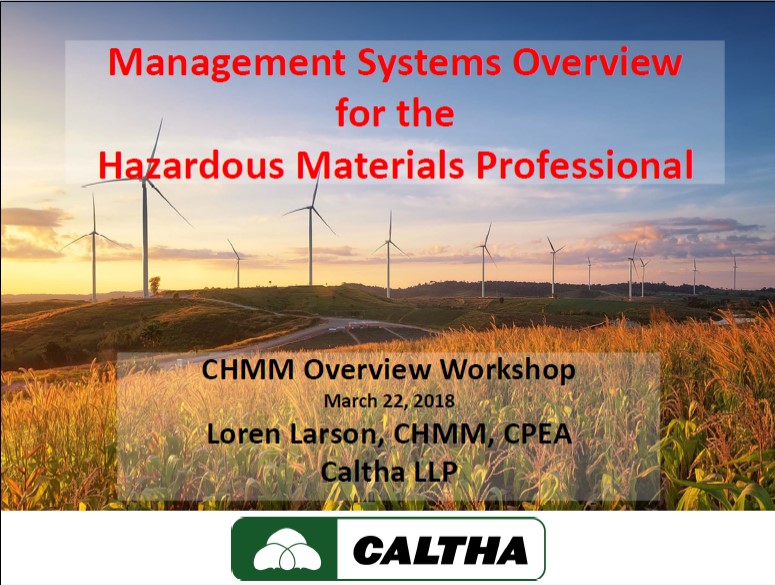
Overview of EHS Management Systems For The Hazardous Materials Manager - EH&S Compliance Professional

The link below provides training slides from the CHMM Review Course on Environmental Management Systems (EMS) and Health & Safety Management Systems.


Presentation Slides: EHS Management Systems Overview for the Hazardous Materials Professional


Caltha LLP provides specialized expertise to clients nationwide in the evaluation environmental rules, developing EHS compliance procedures, and preparing cost-effective EHS management programs. For further information contact Caltha LLP at info@calthacompany.com or Caltha LLP Website

New Washington Interim Policy On Handling Pharmaceutical Wastes Classified As Dangerous Waste

Washington Department of Ecology has developed an interim policy for generators of pharmaceutical wastes which could be classified as “dangerous waste” under State rules. The State has enacted this policy pending US EPA finalizing federal rules to streamline handling and disposal of these wastes. Once the EPA rule is finalized, Ecology expects to adopt the federal rule.


What are the generator requirements under the interim Ecology policy?

Caltha LLP provides specialized expertise to clients nationwide in the evaluation environmental rules, developing EHS compliance procedures, and preparing cost-effective EHS management programs. For further information contact Caltha LLP at info@calthacompany.com or Caltha LLP Website
Sunday, December 11, 2016

Environmental Compliance Training, Waste Management Training, SPCC Training

Caltha LLP provides a wide range of training programs to industrial and government sector clients to meet the requirements of State and EPA rules, permits and related spill and emergency preparedness rules. Training can be provided to large or small groups and is provided either in person at your location, or through a live webinar format. For further information and to request a quote, go to Employer's Environmental Health and Safety Training Center.


The training sessions commonly requested include:
  • Hazardous waste management training
  • SPCC annual training
  • Spill response training
  • DOT hazardous material (HazMat) triennial recertification and initial training
  • Facility compliance training overview (covering a wide range of typical facility environmental compliance topics)
  • Internal compliance auditor training
  • Industrial and construction site stormwater discharge permit training
  • Stormwater monitoring training
  • Training for site inspections
Caltha LLP provides specialized expertise to clients nationwide in the evaluation environmental rules, developing EHS compliance procedures, and preparing cost-effective EHS management programs. For further information contact Caltha LLP at info@calthacompany.com or Caltha LLP Website
Saturday, December 10, 2016

MPCA Delays Enforcement Action On Handling of Hazardous Aerosols & Cylinders

The Minnesota Pollution Control Agency has extended its compliance deadline for one important change to its policies regarding management of spent aerosol cans and gas cylinders that contain hazardous chemicals. Historically, the MPCA had elected not to take enforcement action against hazardous waste generators who empty aerosol cans and cylinders by releasing pressure into the atmosphere, including those who puncture cans with equipment fitted with carbon or other filtration systems to capture vapors. The agency considers this "abandonment" of hazardous waste, which is prohibited.


The MPCA had planned to change its enforcement policy as of January 1, 2017. which would require generators using such equipment to find an alternate means of handling aerosol cans and cylinders. The agency recently announced that it has extended this change to enforcement policy until January 1, 2018, to allow facilities more time to modify their practices, if needed.


Minnesota is one of only a few States that allows aerosol cans and gas cylinders to be handled as though they were universal wastes, although they are technically not regulated as universal wastes under State and Federal rules. MPCA has established some minimum requirements generators must comply with to take advantage of this policy.


Caltha LLP provides specialized expertise to clients nationwide in the evaluation environmental rules, developing EHS compliance procedures, and preparing cost-effective EHS management programs. For further information contact Caltha LLP at info@calthacompany.com or Caltha LLP Website